
Diatonic Progressions
Goal
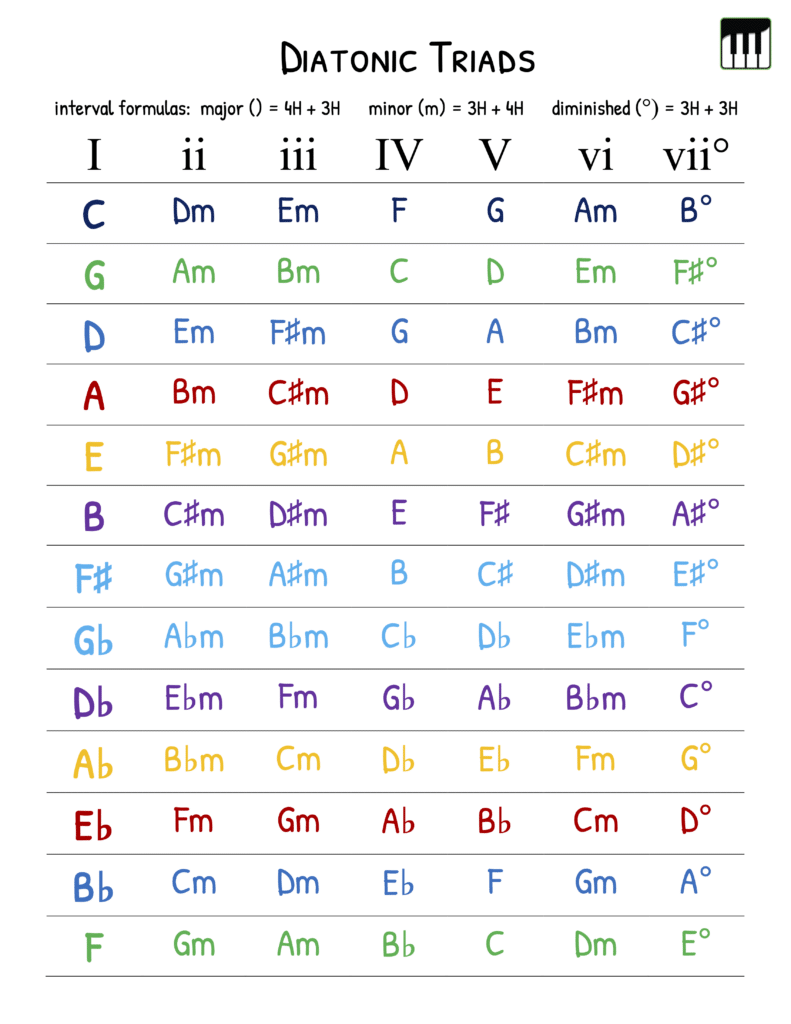
In the key of 1♭, 1♯, 2♭, or 2♯, play a chord progression with smooth voice leading in the RH, while playing each chord root in octaves in the LH.
Vocabulary
• diatonic = using exclusively the 7 notes from one key, which sound stable & cohesive
• non-diatonic = the 5 notes outside of the key, which sound very unstable & dramatic
• diminished triad = 7th diatonic triad of major scale, interval formula: 3H + 3H
Essential Knowledge
• Diatonic chords sound cohesive as a progression.
• We find a set of diatonic triads by playing…
– every other note of a key.
– chords within one slice of the Circle of Fifths plus its 2 neighboring slices. We build major chords on the circle’s outer notes, and minor chords on the circle’s inner notes (this method excludes the diatonic diminished triad).
Tips
• Playing major & minor diatonic triads at random, it will be difficult to come up with a chord progression that doesn’t sound good!
PLAY THIS
1. Choose a key: 1♭, 1♯, 2♭, or 2♯.
2. In that key, find the set of diatonic triads by either playing every other note of the key, or by using the Circle of Fifths.
3. Create a diatonic chord progression using these triads.
4. Apply smooth voice leading to this chord progression.
5. In the LH, add the root note of each chord to create a bassline.
6. In the LH, play these same roots, but now in octaves.
