
Circle of Fifths
Goal
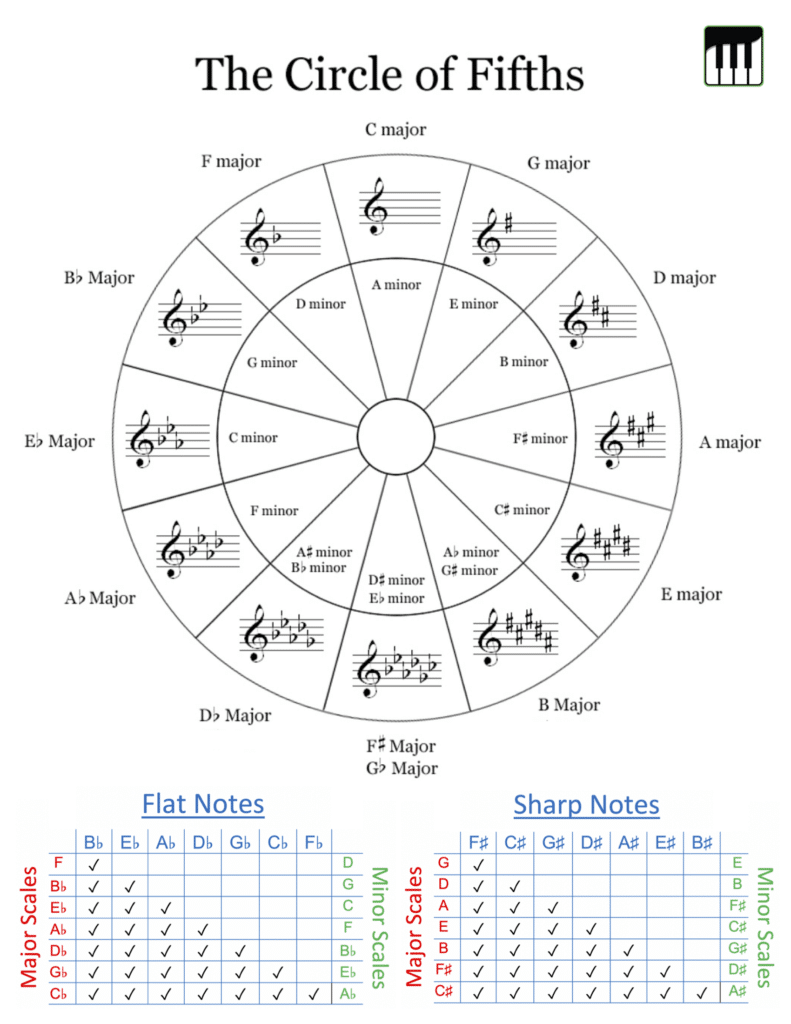
Understand how to use the Circle of Fifths to find the notes of a key.
Vocabulary
• key = set of 7 notes derived through major scale interval formula
• Circle of Fifths = chart representing all 12 keys and their relationships
• key signature = label for a key based on which notes are ♭ or ♯
Essential Knowledge
• Applying the major/minor scale interval formula to all 12 notes gives us 12 sets of 7 notes each. These sets of notes are the 12 keys represented in the Circle of Fifths.
• Each key is named with a key signature, which tells us which notes are sharped/flatted.
• Music that only uses notes from one key sounds cohesive.
Tips
• Moving clockwise in the Circle of Fifths, the new sharp in each key signature is a 5th (7 half steps) up from the previous sharp: F♯, C♯, G♯, D♯, A♯. The newly sharped note is always the 7th note of that key’s major scale.
• Moving counterclockwise in the Circle of Fifths, the new flat in each key signature is a 5th (7 half steps) down from the previous flat: B♭, E♭, A♭, D♭, G♭. It’s also helpful that the first 4 flats in order spell the word “bead.” The newly flatted note is always the 4th note of that key’s major scale.
Fun Facts
• Transitioning between keys is called modulation.
